What Is the Best Shilajit to Buy? A 7-Point Checklist

Search for Shilajit and you'll find hundreds of brands, all claiming to be pure, Himalayan and premium. Prices range from a few dollars to over a hundred, and the labels often look almost identical. So what is the best Shilajit to buy, and how do you tell a good one from a bad one?
We'll be upfront: we sell Shilajit, and we think ours is a good choice. But the checklist below works for any brand, including ours. If a product can't pass it, don't buy it, whoever makes it.
Why choosing carefully matters
Raw Shilajit comes straight out of mountain rock, so before it's cleaned it can carry soil, stone, mould and naturally occurring heavy metals. Properly purified Shilajit has a good safety record in research, but the risk lies in products that skip that step or are padded with something cheaper. [1]
This isn't a theoretical worry. When researchers bought traditional Ayurvedic products online and tested them, about one in five contained detectable lead, mercury or arsenic. [2] That's why the most important thing on any Shilajit label isn't the word "pure". It's proof.
The 7-point checklist for the best Shilajit
1. A named origin, not just "Himalayan"
"Himalayan" is a mountain range spanning several countries, and some brands use it loosely. A trustworthy seller should tell you the actual region. Ours comes from Gilgit-Baltistan, in the Himalaya and Karakoram, and is collected by hand.
2. An independent heavy metals test
This is the one that matters most. Look for a recent report from an independent laboratory testing for lead, mercury, arsenic and cadmium, ideally by a method called ICP-MS. A report from the brand's own lab, or a vague "tested for safety" line, isn't the same thing.
3. Microbiology and aflatoxin results
These show the Shilajit was dried and stored properly and didn't pick up bacteria or mould along the way. Good brands publish them alongside the heavy metals report.
4. Fulvic acid content
Fulvic acid is the main active part of Shilajit, and a stated percentage tells you the product hasn't been watered down. Independent tests put the fulvic acid in our resin at 53%. If a brand won't tell you a number, ask why.
5. A batch number you can trace
Every jar or bottle should carry a batch number that links to its own test results. Without it, a lab report could belong to any product from any year.
6. A certified facility
Look for food-safety certifications such as ISO 22000, GMP or HACCP, and Halal certification if that matters to you. They show that the place where the Shilajit is purified and packed is regularly checked by an outside body.
7. A price that makes sense
Collecting, purifying and testing real Shilajit costs money. A 30 g jar selling for a few dollars is a warning sign, not a bargain. Very high prices aren't proof of quality either. Judge the evidence, not the price tag.
Resin, drops, capsules or powder?
Once you know a brand is trustworthy, the next choice is the form. Here's how they compare.
| Form | Good for | Watch out for |
|---|---|---|
| Resin | The least processed form. Nothing added, and you can see and feel what you're buying. | Takes a minute to dissolve. Strong earthy taste. |
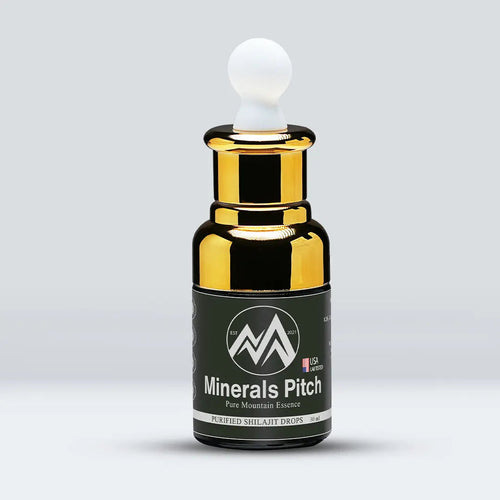
| Drops | Quick, exact amount every time, easy to carry. | Check what liquid it's made with and that it uses real resin. |
| Capsules | Convenient, no taste. | You can't see what's inside. Some contain fillers or very little Shilajit. |
| Powder | Cheap and easy to mix. | Easiest form to bulk out with other powders. |
For most people looking for the real thing, resin Himalayan Shilajit is the best place to start, because it's the hardest form to fake convincingly and the closest to how Shilajit has been taken for generations. Drops are the best alternative if you want speed and convenience without moving to capsules.
What about home tests?
You'll see videos showing how to "test" Shilajit at home: it should dissolve fully in warm water, go soft in your hand and turn hard in the fridge, and not burn with a flame. Genuine resin does tend to behave this way, so these checks can catch an obvious fake.
But they can't tell you anything about heavy metals, mould or how much fulvic acid is inside, and a clever fake can pass them. Treat home tests as a first look, never as proof. The only real proof is a lab report.
Red flags to avoid
- No lab reports, or reports that are years old or have no batch number
- Promises to cure, treat or fix any health condition
- "Gold grade", "premium" or "100% pure" with nothing to back it up
- Reviews that all sound the same, or before-and-after photos
- No physical address or way to contact a real person
How our Shilajit measures up
Here's how Himalayan Pure Shilajit resin stacks up against the checklist. It's hand collected in Gilgit-Baltistan, purified in water and sun dried. Every batch is sent to an independent lab before packing, the production facility holds ISO 22000, GMP, HACCP and Halal certification, and independent tests measured 53% fulvic acid. A 30 g jar lasts about two to three months and starts at $47 with free delivery.
Our full lab reports and certificates are on our lab reports section, and we'll email you the report for your exact batch if you ask. If you'd prefer the convenience of liquid, our Shilajit drops are made from the same tested Shilajit.
Questions people ask
What is the best Shilajit to buy?
The best Shilajit is one with a named origin, recent independent lab reports for heavy metals and microbes, a stated fulvic acid content, a traceable batch number and a certified facility. Resin is the least processed and hardest to fake.
Is resin better than capsules?
Resin is the least processed form, and you can see what you're buying. Capsules are convenient, but you can't check what's inside, and some contain fillers.
How can I tell if Shilajit is real?
Real resin dissolves fully in warm water and softens in your hand, but those checks aren't proof. Only an independent lab report can confirm purity and safety.
Is Himalayan Shilajit the best?
The Himalaya and Karakoram are the best-known sources, but how Shilajit is purified and tested matters more than where it's from. Always ask for lab reports.
Why is some Shilajit so cheap?
Proper collection, purification and testing are expensive. Very cheap Shilajit has often skipped one of those steps or been mixed with something else.
Once you've chosen, read our guide to the best time to take Shilajit, and see what the research says on our Shilajit benefits page.
References
- Stohs SJ. Safety and efficacy of shilajit (mumie, moomiyo). Phytother Res. 2014. PubMed
- Saper RB, et al. JAMA. 2008;300(8):915–923. A study of metals in Ayurvedic products sold online. Read the study
El Shilajit es un complemento alimenticio. Este artículo es informativo y no sustituye el consejo de tu médico.